








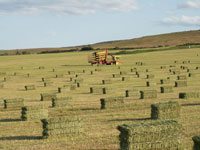
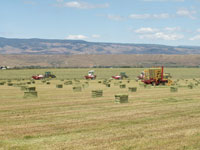
Our focus at Hay USA is on premium hay for horses because finding the right hay for your horses can be a frustrating search. Horse owners are confronted by varying hay qualities and types, not to mention prices. Hay USA will eliminate the "hunt for hay" by offering you simple choices of excellent, clean, digestible, safe hay purchased by the bale in Weatherford, Texas or a semi load delivered to our ranch.
Come look for yourself, do the math and feed it. You will see the difference in your check book by saving money with quality and how our horses look and perform. We know that old habits are hard to break and there are so many misconceptions floating around about hay quality that are passed on through word-of-mouth advice. The following will give you a little Insight on hay terminology and it may answer a few questions while separating opinion from fact.
Every horse has different nutritional requirements. Those needs differ depending on the horse type, age, size, living conditions, allergies, performance levels, etc. . . One thing is in common, quality forage works for all horses. Hay USA offers you a variety of quality hays.
Research has revealed many new facts about equine nutrition, and it is a constantly evolving science! However, several persistent myths regarding the feeding of horses still exist in the horse world.
Alfalfa is excellent hay for horses. But, It is important not to feed a horse like a dairy cow or a dry cow. Let me explain the difference between dairy, dry cow and horse type alfalfa
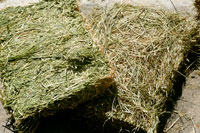
Dairy hay is very pretty, bright green, leafy & with protein levels ranging from 22% to 26%. This alfalfa is sold by the point on TDN because the goal of dairy hay is to produce milk. it is the most expensive alfalfa on the market and not suitable for horses. It can be bailed in small squares, rounds , 1 ton or 1/2 ton bales.
Dry cow hay is often a second quality alfalfa. it is less expensive than dairy and horse hay for obvious reasons. The color is often low. It may have been rained on in the stack, the windrow or on the bale in the field. The protein ranges from 10% to 22%. The goal of dry cow hay is to fill the cow in a cost effective manor and give substantial roughage to get the gain for slaughter. Being a #2 hay is less expensive. It is often striped, very mature, tobacco cured, shattery, off color and it is not surprising to see a little mold. This second grade hay is sufficient for cattle in the feed lot and baled in the most cost effective way in way usually 1 ton or 1/2 ton bales.
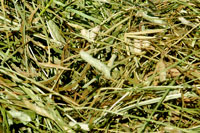
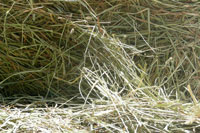
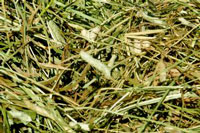
Horse hay has a clean aroma with a good stem to leaf ratio. It is soft to the touch, dry in moisture and consistent. The color is bright and it is palatable being weed free and free of mold and trash. The stem can be in three stages of fine, medium or heavy. The protein levels of good digestible alfalfa can range from 14% to 20%. Be sure you are feeding alfalfa that is produced for horses. When buying alfalfa be cautious of Blister Beetles. Do your research. Hay USA recommends hay from the west cost to lessen the potential of Blister Beetle infestation. Horse hay is usually bailed in a smaller package of two and three string bales weighing from 60# to 140#.
it is still widely rumored that alfalfa hay is not suitable for horses of any type, let alone a young foal or brood-mare, because it is "too rich." In actual fact, alfalfa hay, while it is very nutritious, is an excellent choice of hay for the young horse or brood mare. This is because alfalfa hay is higher in protein and other essential nutrients verses grass hay and protein is necessary for tissue growth and development.
Of course, another one of the rumors about equine nutrition is centered around protein. It has long been passed about that excess protein is a cause of a many of problems. While not exactly cost-effective, feeding excess protein will do little to harm your horse. The horse's system will filter out the unnecessary protein and pass it in the urine. If you are feeding a high protein diet and noticing excessive urination or an ammonia smell to your barn, that might be a clue that you need to cut back on the protein. Even in young growing horses, it has been shown that high protein is NOT linked to developmental orthopedic diseases.
Alfalfa hay is comparable in terms of calorie content and Crude Protein content to fresh pasture grasses. It is, however, considerably higher in
calcium than grasses so supplementation with a vitamin-mineral supplement designed to be fed with legumes is recommended when feeding alfalfa as a sole source of forage. Alfalfa hay is actually lower in many nutrients than fresh growing pasture grasses. Fresh pasture feeding requires management and supplements. Beware of a green pasture, it looks like "horse heaven" but, it can be "horse hell" if not properly managed. Pasture foundering a horse on fresh grass is very common. High calcium levels need to be watched for all horses. Horse quality alfalfa mixed with clean grass hay or managed pasture time is a excellent recommendation and a very balanced diet.
We deal with hundreds of horse owners, all of them have different needs, for instance, some can not tolerate high protein and others are sugar intolerant . Foundered horses do better wit a low sugar and protein content. The only way to lower the sugar content in any hay is to soak it for 30 minutes to one hour.
Nutritional value of all hays, whether legumes or grasses, is primarily related to stage of maturity when the plants are harvested. Timothy plants are sensitive to time of cutting (stage of maturity when cut) and cutting at the wrong stage of maturity is damaging to the plants. Cutting timothy too early
can shorten the life of the stand. Orchard grass is not sensitive to time of cutting and can be cut at earlier stages of maturity. The recommended time of cutting for orchard grass is the late boot to early heading stage (boot stage is when the grass inflorescence is enclosed by the sheath of the upper most leaf -head not yet showing). The recommended time of cutting Timothy is later -the fully headed (inflorescence fully emerged) to early bloom stage (emergence of anthers in the uppermost portion of the inflorescence).
Orchard grass matures much earlier in the growing season than timothy. Orchard grass reaches the late boot to early heading stage in early to mid-May. Timothy reaches the fully headed to early bloom stage in early to mid-June. Weather conditions are usually much more favorable for haymaking in June than in May so there is less likelihood of timothy hay being musty or moldy than orchard grass.
Can horses eat round-baled costal bermuda hay ?
The most important factor to consider when looking for hay for your horse is the quality of the packaging. If you don't have the equipment necessary for moving round bales (which can weigh as much as 800 pounds), then we recommend staying with small squares even though rounds are easy there are many important things to consider. If round bales are not in a barn or properly tarped and exposed to the weather, there is considerable waste to consider. The loss of a round bale is 1/3 of the entire outside of the bale. Round bales appear cost effective but often they are not. It depends on your producer and the management of the hay in the fields. Your horse will often only eat the center of the bale and use the rest for bedding or it is urinated on. if you plan to group-feed it in the paddock, make sure you have a round-bale feeder in order to minimize wastage. Perhaps more importantly, though, you need to make sure that it is mold-free. Due to the large size of the bales, combined with a humid climate, development of mold is favored. Even if the bale starts out mold-free, if you have a small number of horses (less than 4), the hay may be out in the elements long enough to develop mold. There is a potential for botulism, a bacteria that favors warm moist environments, to also be present. It is for this reason that you should talk to your veterinarian about vaccinating your horses against botulism if you plan to feed round bales. Also, the longer the hay is exposed to sun and rain, the higher the chances are that your horses will refuse to utilize all the hay. Round bales are often very mature and not a high quality bermuda. This type of hay can be ropy and burn calories as they try to digest it and round bales t are the #1 reason for impaction. Be sure to feed ample alfalfa if you use round bales this will lessen your chances of impaction. Round-baled hay is usually much cheaper to purchase on a weight-basis, but it is not going to be ideal for all management situations. Round bales are a excellent choice for cattle because they will "clean it up" and digest this type of hay. It is very cost effective roughage for that situation.
Hay that has been stored in the barn for a year or more has maintains its nutrient value. As long as the hay has been stored in a dry environment, the only significant loss is Vitamin A, and most of that loss occurred in the first 6 months of storage. The greatest loss of Vitamin A activity occurs right after harvest. The amounts of energy, protein, calcium, phosphorus and other nutrients and minerals remain basically the same after 2 years of storage as they were after the first month or two of storage. With time hay will loose its fresh smell but that does not affect nutrient value. If someone offers you to sell their good quality barn-stored" last year's hay" at a bargain-basement price-take them up on it!
In summary, sorting out fiction from fact and knowing the nutrient requirements of your horses can make selecting the right hay easy. High quality,easily digestible legumes and grass/legume mix hays are ideal for young growing horses and brood mares due to the high protein and calorie
contents. That high protein may be too much for the show horse, though, and in order to increase feed efficiency, a high quality grass hay should be chosen. Be prepared to supplement foals, brood mares and exercising horses with additional calories if the hay is of marginal quality.
Pasture potatoes can make do with a quality grass hay. if you do feed the pastured pleasure horse a very high protein hay, you may find a fat horse in a short time frame! The "cutting" doesn't matter nearly as much as the maturity of the hay when it was cut. Learn how to evaluate hay quality by visual scoring and you'll be able to select the right hay regardless of what season it was cut.
So the primary considerations are stage of maturity, leafiness, freedom from musty odor, mold and foreign material - Its not the species of hay but farming management.
For example, 3 week old bermuda grass hay or alfalfa will have a higher forage quality than 4 week old, greater than 5 week old. . . Nitrogen fertilization directly affects the crude protein content of grass, with maturity at cutting held constant; the higher the fertilization the higher the crude protein ... Further, each forage species has a maximum crude protein level. The major contributing factor is plant/forage maturity at time of cutting. Forage quality decreases as the plant matures ... period!
Even though I use this term, Beware of the sign that says "horse quality hay" ... there is no such thing a it's only a marketing term, usually "implying" high (undefined) quality and seldom tested. A sign reading "highly fertilized bermuda grass hay" (or any other type of hay} means next to nothing. A reputable local producer or hay dealer is your horses best friend. Always know the origin of your hay especially on alfalfa because of the Blister Beetle infestation. Alfalfa from the west cost is as safe choice. Feel the weight verses listening to the feed store owner, 10# makes a big difference in the real cost, remember to do the math and be sure you are getting what you are paying for.
2000# / bale weight = ______ bales per ton x bale cost = price per ton.
In general, horses are not as picky as horse owners. But your horse depends on you.
20 years in the hay business I have learned there is option and fact and it is often hard to tell the difference. Have fun learning on the Hay USA website.
Liz Blitzer
President Hay USA Inc.
Nation
wide Call 817-599-0200
for current retail and full load prices.
Hay USA Inc. feeds a wide variety of horses.
We supply hay for top performing horses, breeding facilities large and
small to the
back yard horse owner.
Our clients are educated and can not afford to take risks.
That is why they buy from Hay USA Inc.
Hay USA Inc. |
|
|
|
Business Hours 10 - 6 Tuesday - Saturday |
|
   |
|
 |
|